

Which Solar Tariffs Will Affect 2027 Procurement
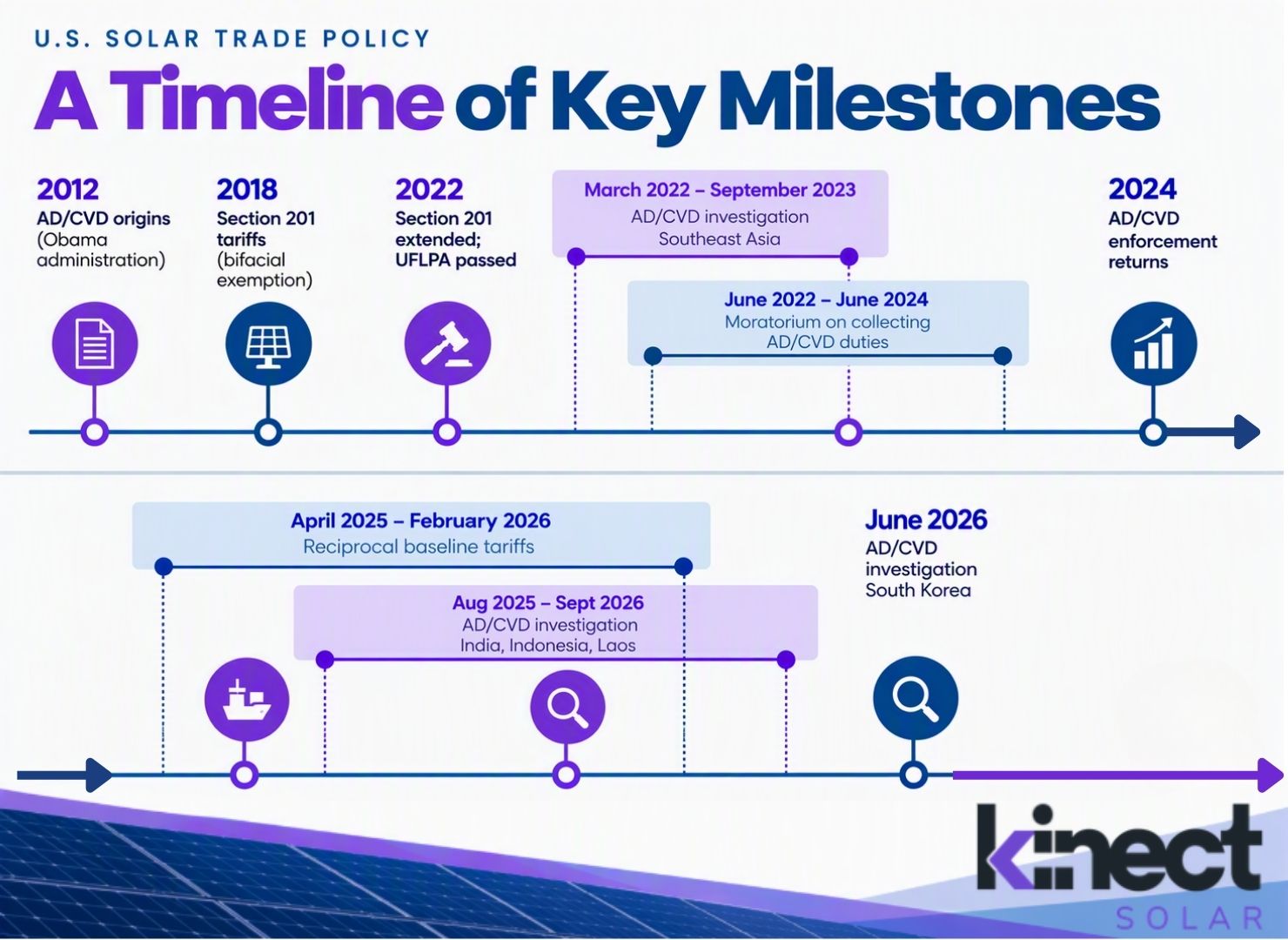
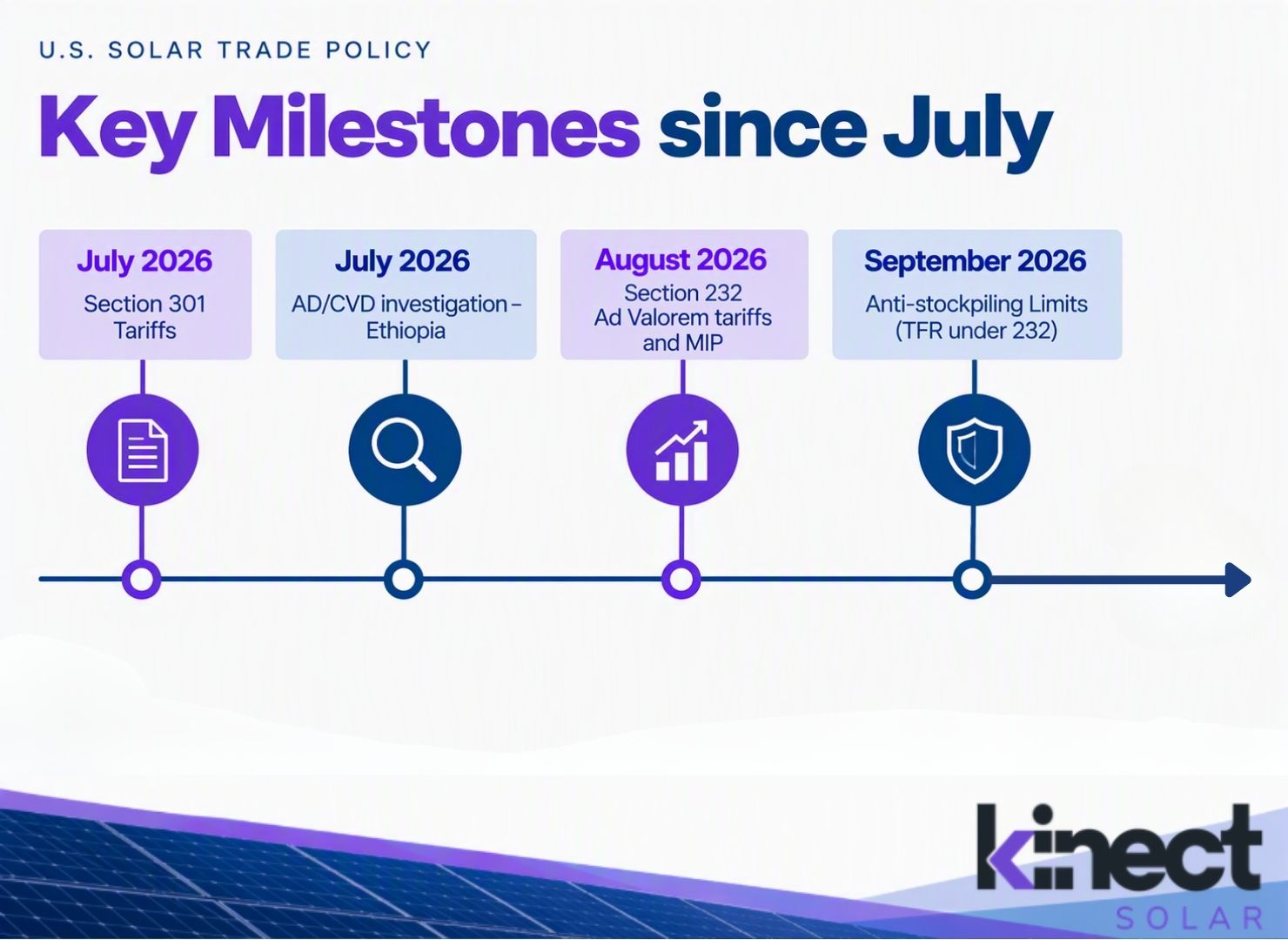
Solar policy changes are part of the normal market, but the second half of 2026 introduced an unusually high number of new rules. The most significant change is likely new Section 232 rules, which include Minimum Import Prices (MIP) and a 15% ad valorem tariff for polysilicon imports and derivatives.
There have also been changes to Section 301 and continuing additions to AD/CVD penalties. Each of these tariffs are significantly shaping the market.
How Minimum Import Prices and the 15% Tariff Affect Solar Module Costs
Under Section 232, MIP and the 15% ad valorem tariff take effect December 4, 2026. Sales contracts that were executed before August 6, 2026 are not subject to the full enforcement. Commerce may adjust the MIP over time.
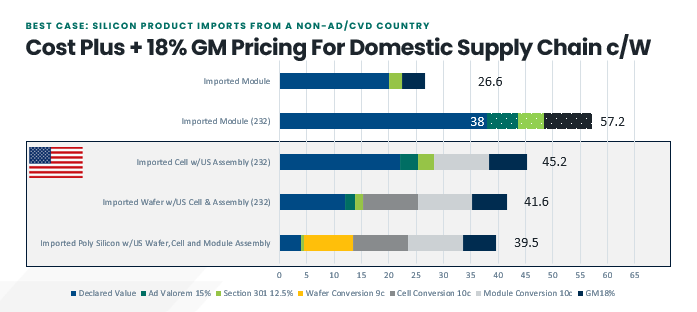
The Section 232 MIP and ad valorem are designed to promote onshore manufacturing, and they do exactly that. The tariffs drive prices up for imported modules and impose lower penalties when US manufacturing has a part in the supply chain. The lowest rates apply to modules made from imported raw polysilicon. Purely domestic products are not subject to tariffs (very few of these exist in today’s market, but thin-film is one such option).
How Section 232, Section 301, and AD/CVD Tariffs Stack on Solar Imports
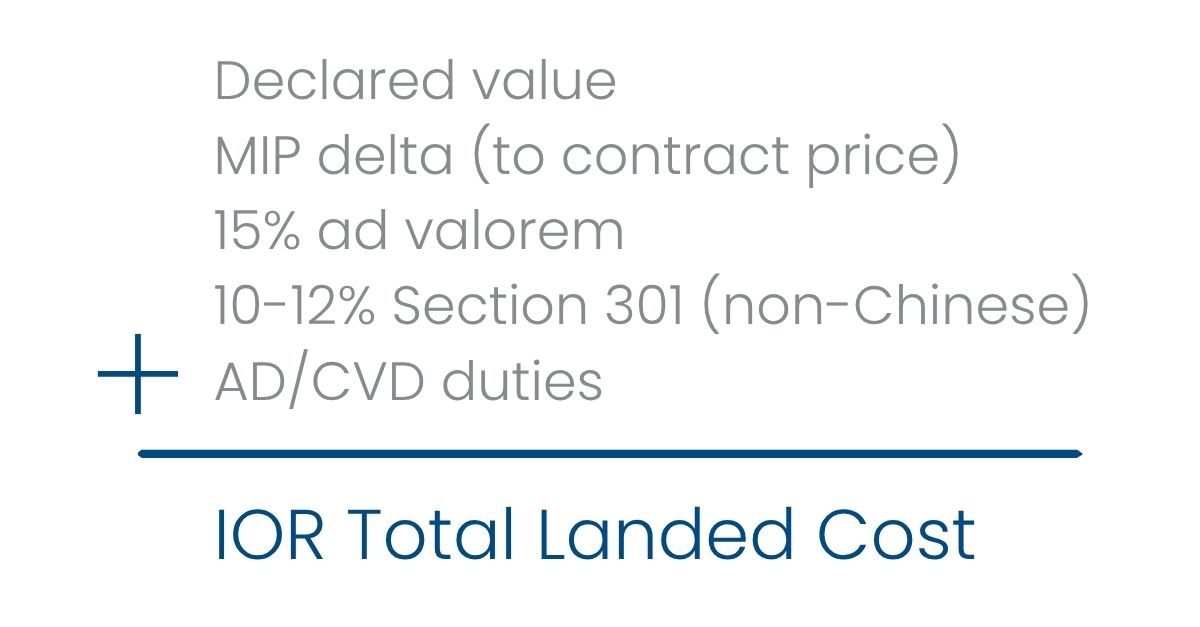
Section 232 duties stack with existing tariffs. This means imported modules are subject to the MIP, the 15% ad valorem, AD/CVD penalties, and section 301 tariffs. (Some exceptions apply for the UK, EU, Japan, South Korea, Taiwan, Switzerland, and Lichtenstein.)
How Section 232 Could Reshape the US Solar Supply Chain and Module Availability
Imported modules that are subject to AD/CVD will likely be too costly to import. Modules that are not subject to AD/CVD are commercially viable, even selling at the MIP. It remains to be seen how much, if any, of the tariffs, importers will absorb, and how much will be passed to the customer.
Of course, even if the importer does absorb tariffs, procurement could be riskier due to the potential for an importer’s certification to be rejected or for commerce to increase MIPs.
The lowest landed costs are likely to be realized by US manufacturers, IF they can recapture profit from cells imported at the MIP when AD/CV also applies.
The market price of domestically manufactured solar panels will also hinge on available supply. The US currently has an annual demand of approximately 45GW, and growing. There are about 50GW of operational module assembly today, with about 50GW more announced. Cell production stands at 65GW announced with only 15GW currently operational, and wafer production is the most limited with only a very small amount in operation now.
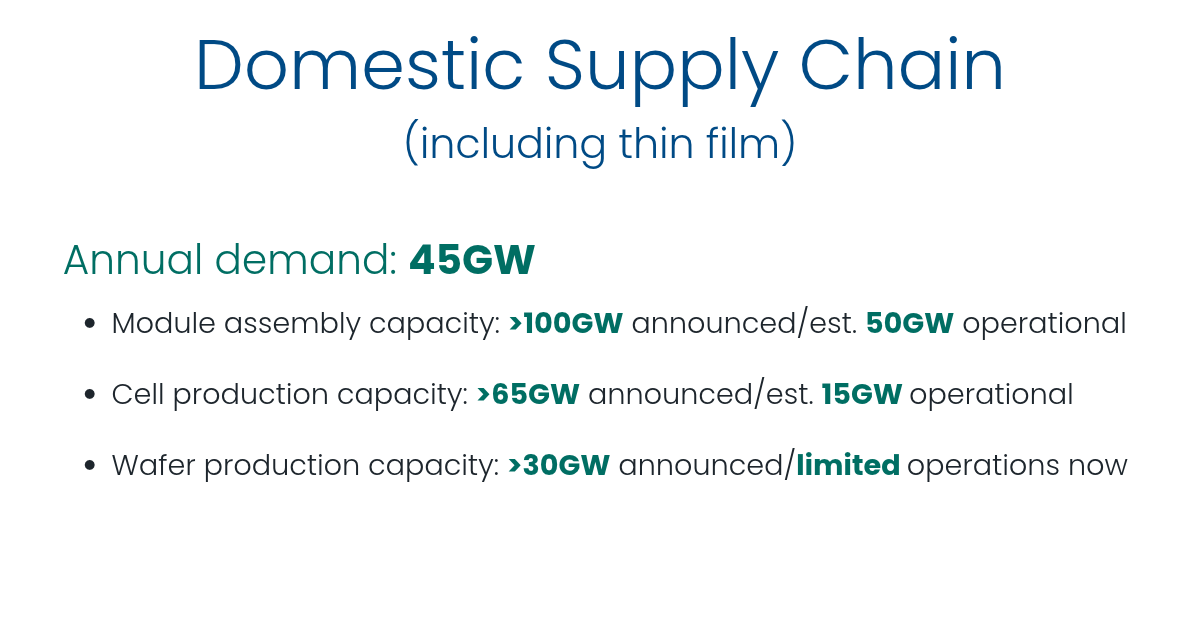
Though there appears to be enough capacity to support demand at the module assembly level, following the supply chain upstream reveals a bottleneck for domestic supply. Most likely: the manufacturing industry will continue to rely on expensive imports, potentially with complicated and widely-varying tariff stacks (depending on countries of origin).
What Solar Developers and EPCs Should Do Before Their Next Module Purchase
Solar developers and EPCs must be very careful about who they work with to source modules in a market environment of stacking tariffs and steep penalties. Experience will be key to minimizing risk. Other things to consider when making procurement decisions for 2027:
- Check supply contracts carefully. Understand which party carries the risk (and when) for imported polysilicon and derivatives.
- Re-price the pipeline with a floor of $0.38/W for imports.
- Consider thin film for your projects. It’s the lowest-cost domestic content not subject to Section 232 or AD/CVD risks.
- Don’t silo logistics and procurement. With an effective warehouse strategy, it can be more cost-effective to source modules early and store until receiving is ready.
Additional resources
- View Kinect Solar’s October 30, 2026 webinar about Section 232 and the solar supply chain
- Explore solar equipment that’s already landed in the US, or is domestically made
- Get a free warehouse quote
- Posted in Featured, Regulation, Solar Industry, Solar Panels
- Tagged in Solar developers, solar imports, Solar Policy, solar tariffs