

What Changed
In August 2025, IRS Notice 2025-42 eliminated the 5% safe harbor for most solar projects, requiring developers to rely on the physical work test to establish construction start.
On June 7, 2026, a U.S. District Court vacated that guidance and restored the 5% safe harbor for large-scale solar projects (>1.5MW).
The court determined that the IRS did not sufficiently justify removing the rule or consider how heavily the industry relied on it.
For purposes of the solar industry, the FEOC rule prevents projects that use too many Chinese components from claiming federal investment tax credits under sections 45Y and 48E. It also prevents US manufacturers that use too many Chinese components from benefitting from section 45X credits.
Components from other designated foreign entities are affected too, but Chinese-made products are most likely to affect the solar industry. Other prohibited entities are Russia, North Korea, and Iran.
Why This Matters for Developers
The reinstatement reintroduces one of the industry’s most practical tools for maximizing tax credits and project ROI. Under the 5% safe harbor:
- Developers qualify by incurring at least 5% of total project costs
- The threshold is objective and auditable
- It reduces exposure to interpretation risk inherent in the physical work test
Previously, this method had been restricted to projects ≤1.5 MW, significantly limiting its use for utility-scale solar.
The current ruling temporarily reopens that pathway for larger projects, restoring flexibility in how developers structure project timelines and tax credit strategies.
A Narrow and Uncertain Window
While impactful, the opportunity could be limited:
- Projects must still begin construction before July 5, 2026 to qualify for 45Y and 48E credits
- The ruling may be appealed or replaced with new guidance
- The timeline to act is measured in weeks, not months
Speed and execution become critical factors.
Safe Harbor Is Only Part of the Strategy
For many developers, qualifying for the base ITC tax credits is only a starting point. They should also focus on maximizing their tax credits.
The Domestic Content Adder adds a valuable incentive but introduces additional requirements:
- Projects must meet U.S. manufacturing thresholds for key components
- Procurement decisions directly affect bonus eligibility
- Documentation and traceability are critical
Importantly, the recent court decision does not change domestic content rules, meaning developers must align safe harbor execution with sourcing strategy.
How Inventory Availability Impacts Safe Harbor Execution
With the reinstated 5% safe harbor, the ability to secure and allocate equipment immediately becomes a key enabler.
Projects that can secure equipment immediately, lock in pricing and documentation, and align procurement with domestic content strategies, are better positioned to execute successfully.
For example, access to First Solar modules and other domestically made equipment can support both:
- Rapid cost incurrence for safe harbor qualification, and
- Alignment with domestic content objectives, depending on project structure
From Strategy to Execution
Developers evaluating this opportunity should focus on four key questions:
- Can we incur 5% of total project costs before July 4?
- Is that spend tied to deployable, compliant equipment?
- Does our procurement strategy support domestic content eligibility?
- Do we have the documentation needed to support both positions?
Answering these questions requires alignment across finance, procurement, and compliance teams—under tight time constraints.
Supporting Safe Harbor Execution
With pressure to act immediately, execution support becomes critical.
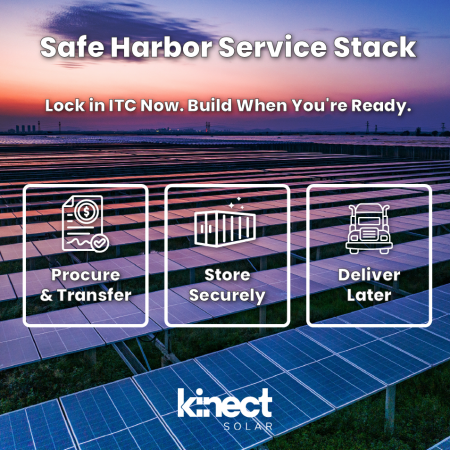
Kinect Solar works with developers to support safe harbor strategies at scale, including:
- Equipment sourcing and allocation
- Inventory access and logistics coordination
- Documentation aligned with tax credit requirements
With access to a broad inventory base—including First Solar modules—Kinect Solar helps developers move from strategy to execution within compressed timelines while maintaining compliance.
Conclusion: A Tactical Opportunity
The reinstatement of the 5% safe harbor represents a tactical opportunity, not a long-term policy shift.
For utility-scale projects, it reopens a proven and financeable pathway to tax credit eligibility. However, the timeline is short, and regulatory uncertainty remains.
Success will depend on the ability to:
- Move quickly
- Align procurement with both safe harbor and domestic content requirements
- Execute with strong documentation and supply chain coordination
For developers prepared to act, the next few weeks may be a critical window to optimize project economics and preserve tax credit value.
* Kinect Solar makes no representations, warranties or guarantees regarding tax credit eligibility by any customer purchasing our products, any end user or successor in interest to the Products, or any property, project, system or facility claiming such credits, nor does it provide tax, legal, or accounting advice. Customers are strongly advised to consult your own tax, legal and accounting advisors regarding eligibility of your property, projects, systems or facilities for tax credits under Sections 45Y, 48E or any other provision of the Code.
- Posted in Regulation
- Tagged in Investment Tax Credit (ITC), Solar developers, Solar Policy