
What “safe harbor” means for residential, DG, C&I, and community solar developers
The One Big Beautiful Bill Act (OBBBA) significantly curtailed the timeline for solar projects to qualify for the Investment Tax Credit (ITC). Only projects that are placed in service by the end of 2027 or establish beginning of construction by July 4, 2026 can now qualify.
Projects that meet beginning of construction requirements before July 4 are “safe harbored” and have four years to complete construction under 4-year continuity safe harbor requirements.
This effectively means that solar developers can secure a 4-year build window, allowing more projects to reap ITC benefits, by meeting ITC safe harbor guidance.

How the solar safe harbor 5% rule works (and what Treasury guidance requires)
Safe harbor guidelines also changed under the OBBBA (you can review those changes here.) Now only solar projects ≤ 1.5 MW AC can establish beginning of construction by meeting the 5 percent rule (or five percent safe harbor).
Under this rule, a project is considered under construction if the taxpayer has incurred at least 5 percent of the total cost of the eligible project. Solar projects can reach the 5 percent benchmark by purchasing solar panels or other equipment required for the project.
Why safe harbor now: Lock in ITC, domestic content, and tariff exposure
Using the 5 percent rule now to meet start of construction safe harbor requirements has several advantages, including but not limited to:
- Extending the window to complete projects and claim ITC credits by as much as 4 years
- Locking in the domestic content bonus at its current 50% requirement for 2026 (in 2027, 55% of a project’s equipment must be domestic content to qualify for the bonus)
- Protecting against tariff exposure by purchasing before tariffs change (for example, pending Section 232 increases)
- Securing solar equipment at current, low prices
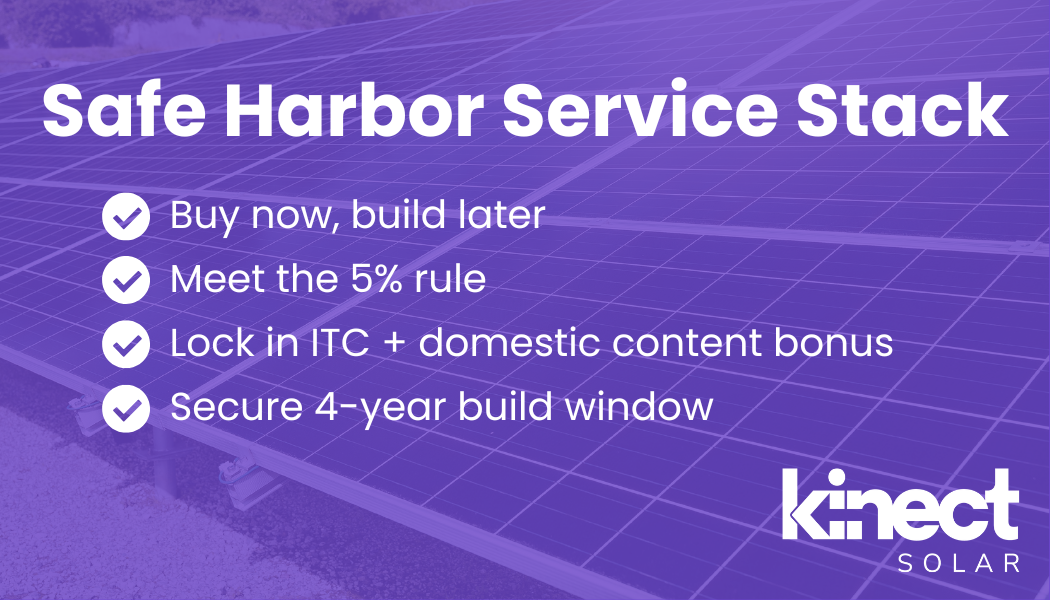
The Safe Harbor Service Stack (transfer, storage, and delivery to purchase now, build later)
To help solar developers lock in these safe harbor advantages, Kinect Solar offers a customizable Safe Harbor Service Stack. We bridge the gap between when you need to purchase equipment to qualify for the ITC* and other safe harbor advantages (now) and when you need that equipment to be delivered to a project site (later).
The Safe Harbor Service Stack allows you to transfer ownership, store equipment, and schedule delivery when you need to. Services include, but are not limited to:
- Payment terms structured to meet deadlines in treasury guidance
- Immediate transfers of equipment to buyers to minimize risk of non-delivery
- 4-year storage & project-segregated warehousing (audit-ready)
- Streamlined contract to manage complex project timelines
- Nationwide warehouse location selection, can be flexed to meet sales and inventory tax requirements by state
- Balance of Equipment: complete the BOM beyond the initial Safe Harbor purchase
- Domestic content access for carports, ground mount, fixed tilt, and trackers (inquire about rooftops)
Who this is for: Portfolios comprised of projects ≤1.5 MW AC each
Kinect Solar’s Safe Harbor Service Stack will primarily benefit residential, DG, C&I, and community solar developers, or any developers whose portfolios include sub-1.5MW AC solar projects. (Projects that can use the 5 percent rule.)
Solar ITC benefits are not the only reason to safe harbor, however, and our Service Stack solutions are available to customers and projects of any size. Larger project developers who wish to take advantage of current pricing, tariff, and FEOC conditions can also benefit from many Service Stack choices.
Timeline and deadlines: What developers need to do
To meet Treasury safe harbor guidance, payment for equipment must be registered BEFORE the treasury deadline of July 4, 2026.
We strongly recommend you DO NOT WAIT UNTIL IT IS TOO LATE! The selection of equipment available for you to choose from, that also meets delivery deadlines (105 days after July 4, 2026), is likely to diminish as the July 4, 2026 deadline gets closer.
Next steps: How to evaluate fit and get a quote
We have solar equipment and safe harbor experts standing by to consult on your project requirement today, with no commitment required.
* Kinect Solar makes no representations, warranties or guarantees regarding tax credit eligibility by any customer purchasing our products, any end user or successor in interest to the Products, or any property, project, system or facility claiming such credits, nor does it provide tax, legal, or accounting advice. Customers are strongly advised to consult your own tax, legal and accounting advisors regarding eligibility of your property, projects, systems or facilities for tax credits under Sections 45Y, 48E or any other provision of the Code.